How dizziness and tinnitus show up together
It can start as a quick “tilt” when you turn your head, and then you notice a faint ringing that wasn’t there a minute ago. The pairing often feels inconsistent—fine at breakfast, unsettled by mid-morning—so it’s easy to wonder if you imagined the sound or overreacted to the dizzy spell.
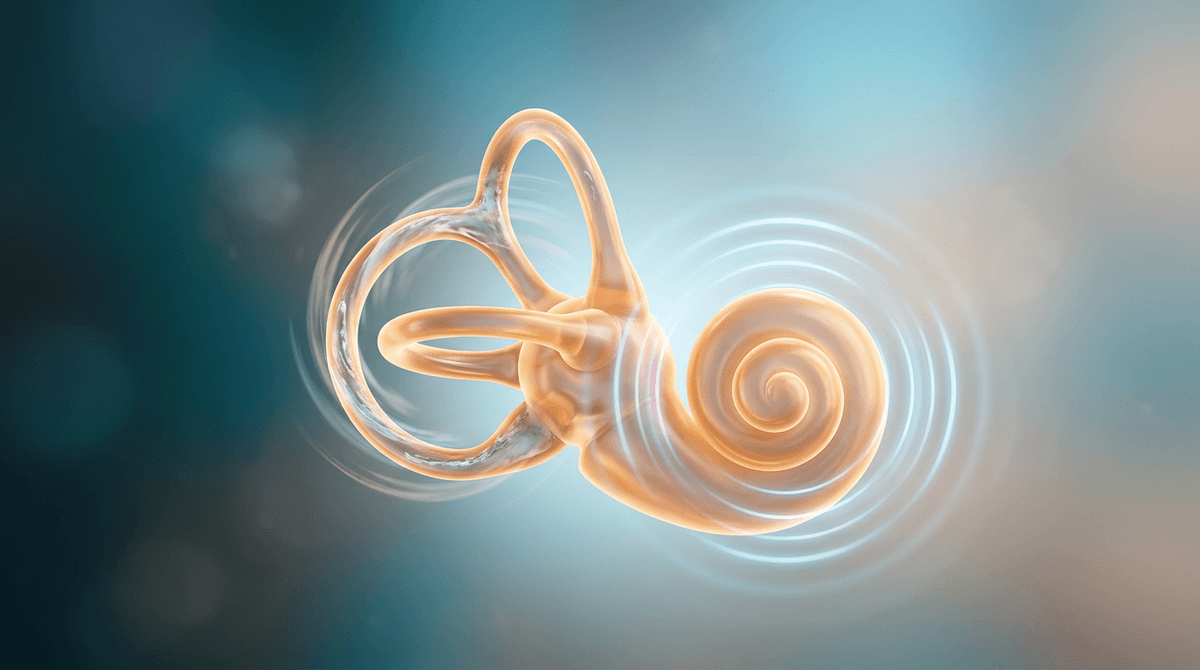
These two symptoms can show up together because the ear isn’t just for hearing. Inside, tiny sensors for balance sit close to the parts that pick up sound, and they share the same narrow space and wiring. When that area is irritated—after a cold, a loud night out, or even a new medication—signals can get “noisy,” so your brain receives confusing movement information at the same time it picks up a new buzz or tone.
Some people notice ringing first, then lightheadedness; others get a spinning wave and only later realize one ear sounds “full.” If either symptom is sudden, stronger than usual, or hard to ignore, it helps to treat that change as a real data point rather than pushing through it.
What drives the shared inner-ear pathway
Sometimes it’s the “pressure” feeling that stands out first—like your ear won’t pop—while the room still looks steady. Then you shift your gaze or stand up, and the balance part catches up, making the whole episode feel oddly mismatched and hard to describe.
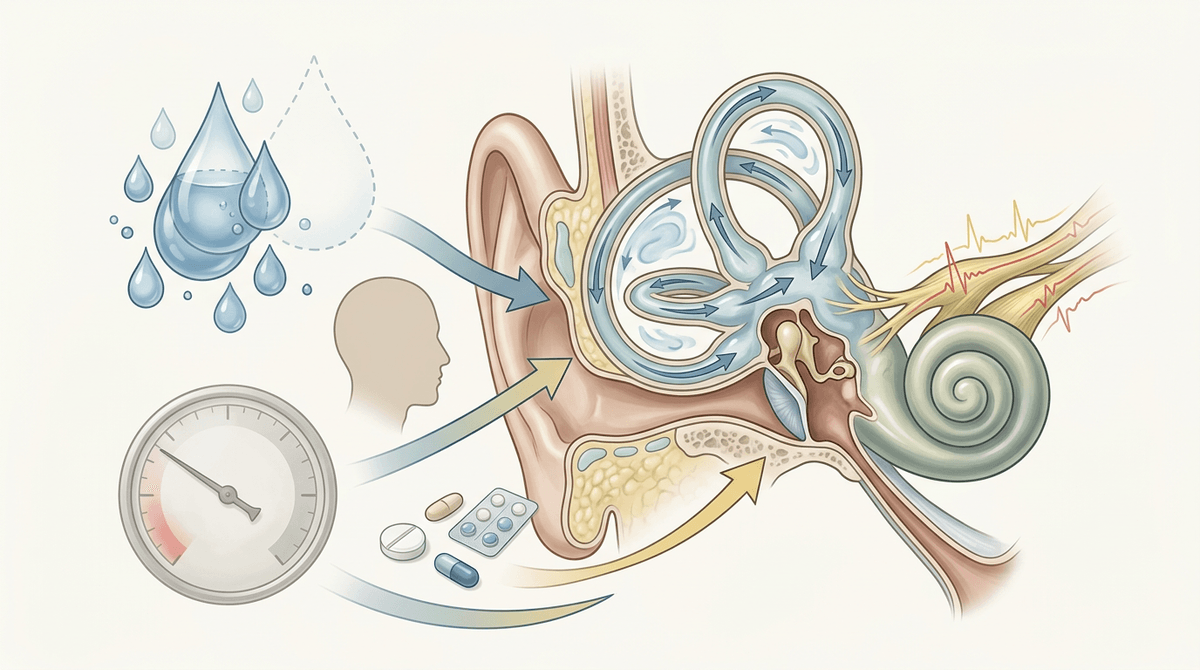
One reason the symptoms can travel together is that hearing and balance share the same inner-ear fluid system. Sound and motion are both translated by tiny hair cells that sit in fluid-filled chambers; when that fluid chemistry or pressure shifts even a little, those sensors can misfire. The brain can interpret that mixed input as ringing (an added signal that isn’t coming from the outside) and dizziness (movement information that doesn’t line up with what your eyes and muscles report).
Inflammation after a cold, sudden noise exposure, migraine-related nerve sensitivity, or certain medications may all nudge this system in different ways, which is why one day it’s a buzz and the next day it’s spinning. If the pattern is changing quickly, it’s worth treating that shift as meaningful rather than “just stress.”
Circulation, pressure, and nerve sensitivity changes
On some days the ringing seems to “rise” when you stand up fast, or when you’ve gone too long without water, and the dizziness feels more like a floaty near-miss than a true spin. That can be confusing, because it may not feel like an ear issue at all—more like your whole system is slightly off, without a clear reason.
Part of that is supply and pressure. The inner ear runs on a very steady trickle of blood and a very small, sealed fluid space. If blood flow dips briefly (from dehydration, a sudden posture change, or illness) or if your body’s pressure regulation is running a little uneven, the balance sensors and hearing pathway can get less stable at the same time. The brain may “fill in” the gap as sound—ringing or buzzing—while your balance signals lag behind what your eyes are seeing.
Nerve sensitivity can layer on top of that. During stress, migraine-prone periods, or after certain medications, the brain may turn up its gain on sensory input, so normal inner-ear noise feels louder and small mismatches feel bigger. The result can be an episode that shifts minute to minute, which is unsettling even when it passes quickly.
Common causes that fit this symptom pairing
It’s often the pattern—not the intensity—that gets your attention: one week it’s a single rough morning after a cold, and the next time it happens after a loud restaurant or a second coffee. That inconsistency can make it hard to decide whether you’re dealing with “just vertigo,” “just ringing,” or something that’s actually linked.
Several common situations can plausibly produce both symptoms through the same pathways. A viral inner-ear irritation (sometimes following an upper-respiratory infection) may inflame the balance side and shift hearing signals, so you notice spinning or rocking alongside new ringing. Benign positional vertigo can create brief spins with head turns, and the tinnitus may be separate—yet it tends to get blamed on the same event because they start close together. Migraine biology can also link them: during migraine-prone periods, the brain’s sensory filtering may run hot, making normal inner-ear noise feel louder while motion signals feel less reliable.
Then there are “background” drivers that don’t feel like ear problems at first: dehydration or blood-pressure dips can make you lightheaded while also amplifying internal sound perception, and certain medications can change fluid balance or nerve excitability in ways that are subtle but persistent. When more than one factor overlaps—illness plus sleep loss, or caffeine plus stress—the pairing can look unpredictable even though the mechanism is additive.
Why self-fixes sometimes make symptoms worse
You might catch yourself trying to “reset” things in the moment—popping your ears hard, taking an extra decongestant, downing coffee to push through the fog, or cutting all salt and fluids because you’ve heard “inner-ear pressure” mentioned. When the ringing and dizziness feel inconsistent, it’s easy to assume a stronger fix will make the next hour more predictable, even if it takes effort.
But these symptoms don’t always come from the same kind of problem. If the inner ear is already irritated, aggressive pressure changes from forceful clearing can briefly jolt the fluid system and make the balance sensors misfire more. Stimulants can tighten blood vessels and raise nervous-system “gain,” so ringing feels sharper while lightheadedness feels more noticeable. And some cold or motion medications dry you out or sedate your balance compensation, which may reduce one sensation while quietly worsening another.
A strategy can feel helpful for 20 minutes, then backfire later, making it hard to tell what actually triggered the shift.
Clues that point toward urgent evaluation
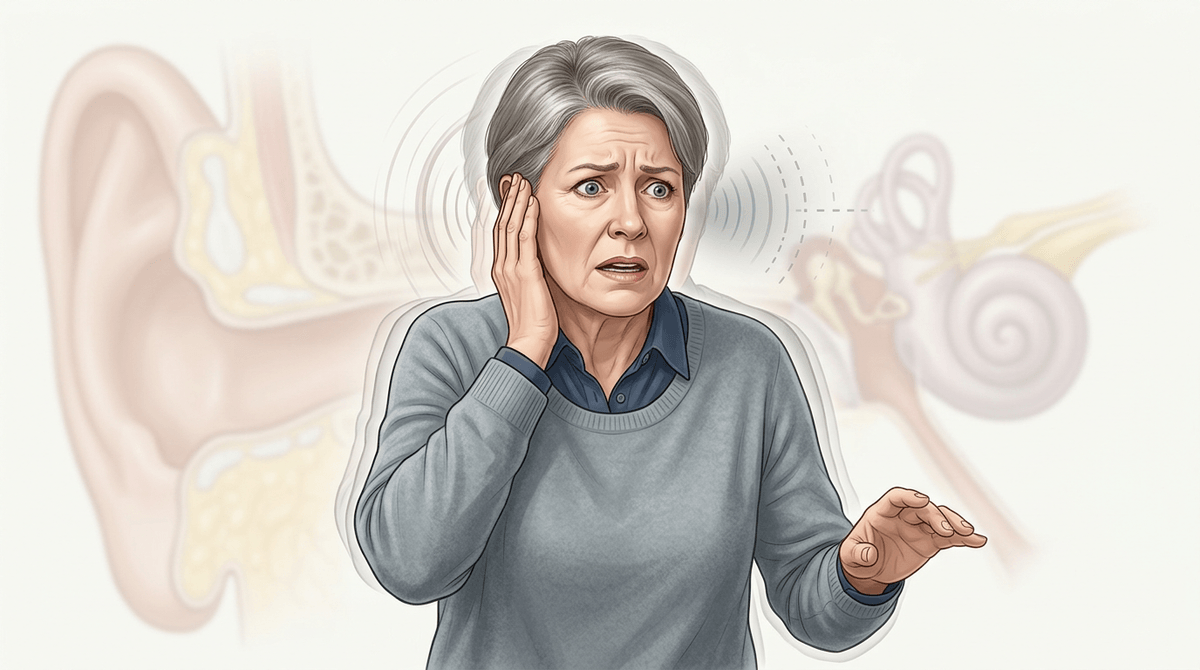
It’s different when the episode doesn’t “settle” into your usual pattern—when the room spin arrives with a sudden, new silence in one ear, or the ringing spikes and your hearing seems to drop over minutes to hours. That kind of change can be easy to misread as congestion or fatigue, but a fast shift in hearing can signal a problem that shouldn’t wait.
Some clues are less about the ear and more about the rest of the nervous system. New facial droop, weakness, numbness, trouble speaking, severe new headache, double vision, or new trouble walking straight suggests the dizziness may not be coming from inner-ear signaling alone. Fainting, chest pain, or a sustained racing heartbeat can also point toward a circulation rhythm issue rather than a “vertigo spell.”
Another don’t-ignore pattern is dizziness plus ear pain, fever, drainage, or a very stiff neck—especially if symptoms keep escalating instead of cycling down. If you’re unsure, the safest cue is the speed of change: a rapid new deficit tends to deserve rapid evaluation.
What a clinician checks to narrow causes
In the exam room, it often becomes clear how much work you’ve been doing just to describe it: “Is it spinning or drifting?” “Did the ringing start first?” Small differences can feel fuzzy in the moment, and that uncertainty matters because different mechanisms leave different footprints.
A clinician usually starts by mapping timing and triggers (position changes, recent cold, loud noise, caffeine, new meds), then checks vitals and hydration cues. They’ll look in the ear canal and at the eardrum, because fluid, infection, or pressure problems can mimic inner-ear trouble. A brief neurologic screen—eye movements, facial symmetry, strength, coordination, gait—helps separate ear-signal mismatch from broader brain or circulation causes.
Hearing testing is often a key fork in the road: sudden one-sided hearing change with tinnitus is treated differently than normal hearing with episodic vertigo. If the story doesn’t line up, targeted tests (positional maneuvers, audiology, sometimes imaging or blood work) may be used to avoid missing the rarer, time-sensitive patterns.